

Global take on energy news
Provided by AGP
Australia Power Market 2026-2034 | National Electricity Market
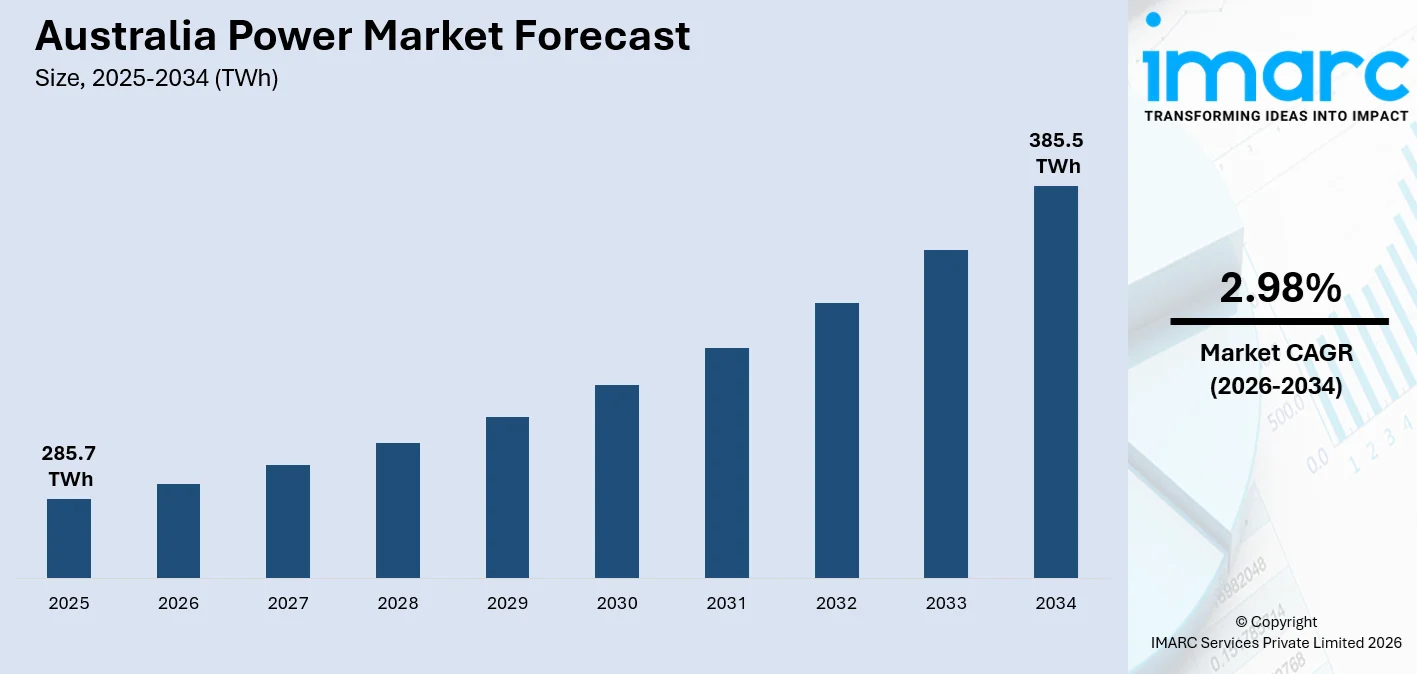
Australia Power Market
Australia’s National Electricity Market pipeline reached 275 projects totalling 56.6 gigawatts (GW) capacity, marking a 24% annual increase, with grid-scale.
AUSTRALIA, May 12, 2026 /EINPresswire.com/ --Market Size: 285.7 TWh (2025)
Forecast: 385.5 TWh (2034)
CAGR: 2.98% (2026–2034)
𝐀𝐮𝐬𝐭𝐫𝐚𝐥𝐢𝐚 𝐏𝐨𝐰𝐞𝐫 𝐌𝐚𝐫𝐤𝐞𝐭 𝐎𝐯𝐞𝐫𝐯𝐢𝐞𝐰
The Australia power market is undergoing a historic transformation as the nation accelerates its transition from fossil fuel dependency toward a diversified, renewable-dominated energy system. The market is integrating record volumes of solar, wind, and battery storage capacity while maintaining grid reliability across one of the world’s most geographically dispersed electricity networks. Renewables are now supplying over half of the National Electricity Market’s generation, marking an unprecedented milestone in Australia’s decarbonization journey. With installed capacity projected to grow from 128.59 GW to 193.75 GW by 2030, the sector is attracting massive capital investment across generation, transmission, distribution, and storage infrastructure.
𝐖𝐡𝐲 𝐈𝐬 𝐭𝐡𝐞 𝐀𝐮𝐬𝐭𝐫𝐚𝐥𝐢𝐚 𝐏𝐨𝐰𝐞𝐫 𝐌𝐚𝐫𝐤𝐞𝐭 𝐇𝐨𝐭 𝐓𝐨𝐝𝐚𝐲?
Australia’s power sector is commanding exceptional attention as renewable energy records are being shattered and battery storage investment is surging at an unprecedented pace. The NEM pipeline is reaching 275 projects totaling 56.6 GW of capacity, marking a 24% annual increase. Battery installations in 2025 are totaling 1.9 GW and 4.9 GWh, outpacing the combined figure for the previous eight years. Nine wind and solar projects are adding 2.1 GW of new capacity in a single quarter alongside 1 GW of battery storage. AGL Energy is commissioning the landmark 500 MW Liddell Battery while Origin Energy is advancing the massive 700 MW Eraring battery project.
𝐌𝐚𝐫𝐤𝐞𝐭 𝐆𝐫𝐨𝐰𝐭𝐡 𝐓𝐫𝐚𝐣𝐞𝐜𝐭𝐨𝐫𝐲 𝐚𝐧𝐝 𝐒𝐭𝐫𝐚𝐭𝐞𝐠𝐢𝐜 𝐎𝐩𝐩𝐨𝐫𝐭𝐮𝐧𝐢𝐭𝐢𝐞𝐬
The Australia power market is witnessing a powerful convergence of electrification trends, grid modernization, and clean energy investment that is creating transformative growth opportunities across the value chain. Transport electrification is accelerating with 157,000 electric vehicle sales representing 38% year-over-year growth. Data centre demand is expected to more than double, potentially reaching 6.5 GW of capacity. Over 140,000 households are installing rooftop solar panels for the first time annually while 185,000 home batteries are being deployed under federal programs. Wholesale spot prices are declining to AU$87 per MWh as increased storage and renewable penetration stabilize market dynamics.
𝐌𝐚𝐫𝐤𝐞𝐭 𝐆𝐫𝐨𝐰𝐭𝐡 𝐃𝐫𝐢𝐯𝐞𝐫𝐬
• Accelerating renewable energy deployment with solar, wind, and hydro exceeding 51% of NEM generation in Q4 2025, supported by a project pipeline of 275 developments totaling 56.6 GW capacity.
• Battery storage investment surging to $2.4 billion with six projects reaching financial close totaling 1.5 GW, while total 2025 installations of 1.9 GW outpaced the combined capacity of the previous eight years.
• Transport and industrial electrification driving structural demand growth, with 157,000 electric vehicle sales representing 38% year-over-year growth and expanding data centre capacity projected to reach 6.5 GW.
• Government policy frameworks including renewable energy zones, federal battery deployment programs, and emissions reduction targets providing strong regulatory support for clean energy transition investments.
• Grid modernization investments including smart metering, AI-enabled predictive maintenance, digital substations, and interconnector expansion planning a 25% increase in transfer capability over five years.
Request a Business Sample Report for Procurement & Investment Evaluation:
https://www.imarcgroup.com/australia-power-market/requestsample
𝐋𝐚𝐭𝐞𝐬𝐭 𝐌𝐚𝐫𝐤𝐞𝐭 𝐍𝐞𝐰𝐬
• March 2026: Edify Energy received approval for the 100 MW Burroway Solar Farm in NSW with integrated 100 MW/400 MWh battery system, generating 214 GWh annually. AGL began commissioning the first 250 MW of the 500 MW Liddell Battery.
• March 2026: Utility-scale solar and wind generation reached 4.7 TWh in a single month, setting a new record for clean energy output across Australia’s National Electricity Market.
• January 2026: Australia is set for massive utility-scale solar and wind investment in 2026, with multiple large-scale projects securing financing and planning approvals across Queensland, NSW, and Victoria.
• Q4 2025: Nine wind and solar projects added 2.1 GW of new capacity and 1 GW of battery storage in a single quarter — more renewables switched on than in any other quarter on record.
• August 2025: A leading Australian energy operator deployed next-generation digital substations with AI-enabled predictive maintenance, achieving a 17% reduction in outage frequency.
𝐀𝐮𝐬𝐭𝐫𝐚𝐥𝐢𝐚 𝐏𝐨𝐰𝐞𝐫 𝐌𝐚𝐫𝐤𝐞𝐭 𝐒𝐮𝐦𝐦𝐚𝐫𝐲
• Renewable energy is surpassing 51% of NEM generation for the first time in Q4 2025, with solar PV leading at 22 GW installed capacity and wind charting 43% year-over-year growth with 1,200 new projects online.
• Battery storage capacity is experiencing exponential growth with 1.9 GW and 4.9 GWh installed in 2025 alone, and up to 16.8 GW of grid-scale storage projected online by 2027 — seven times current levels.
• The NEM project pipeline is reaching 275 developments totaling 56.6 GW capacity, marking a 24% annual increase, with grid-scale batteries accounting for nearly half of new developments.
• ACT & New South Wales is commanding 34.1% of the national market, driven by large-scale solar, wind, and battery projects including the 500 MW Liddell Battery and 700 MW Eraring battery.
• Wholesale electricity spot prices are averaging AU$87 per MWh across all NEM regions, representing a 27% decrease from the prior year as increased renewable penetration and storage capacity stabilize pricing.
• Over 140,000 households are installing rooftop solar panels for the first time annually while 185,000 home batteries are being deployed under federal programs, accelerating decentralized energy participation.
• Transport electrification is surging with 157,000 electric vehicle sales representing 38% year-over-year growth, creating substantial new electricity demand across residential and commercial charging infrastructure.
• Australia’s smart grid market is growing at 13.70% CAGR toward USD 3.9 billion by 2033, with AI-enabled grid management, real-time monitoring, and automated fault detection transforming network operations.
𝐇𝐨𝐰 𝐀𝐈 𝐈𝐬 𝐑𝐞𝐬𝐡𝐚𝐩𝐢𝐧𝐠 𝐭𝐡𝐞 𝐀𝐮𝐬𝐭𝐫𝐚𝐥𝐢𝐚 𝐏𝐨𝐰𝐞𝐫 𝐌𝐚𝐫𝐤𝐞𝐭
Artificial intelligence is rapidly emerging as a transformative force across Australia’s power sector, fundamentally reshaping grid management, energy trading, renewable integration, storage optimization, and consumer engagement — with the smart grid market growing at 13.70% CAGR toward USD 3.9 billion by 2033.
• AI-enabled predictive maintenance deployed in next-generation digital substations is achieving a 17% reduction in outage frequency, with machine learning algorithms analyzing equipment sensor data to forecast component failures and optimize maintenance scheduling across transmission and distribution networks.
• AI-driven renewable energy forecasting platforms are enabling grid operators to predict solar irradiance, wind speed, and generation output with increasing accuracy, optimizing dispatch decisions and reducing curtailment across the NEM’s growing renewable fleet.
• Machine learning-powered energy trading algorithms are enabling generators, retailers, and battery operators to optimize bidding strategies, forecast wholesale price movements, and maximize revenue from the increasingly volatile spot market driven by renewable intermittency.
• AI-orchestrated virtual power plants are aggregating residential solar, battery storage, and flexible load resources into coordinated grid assets, with 185,000 home batteries enabling intelligent demand response and grid balancing services.
• Smart grid analytics platforms integrating AI with advanced metering infrastructure are enabling real-time monitoring of distribution networks, automated fault detection, and dynamic load management — improving reliability while reducing operational costs across Australia’s geographically dispersed electricity networks.
𝐌𝐚𝐫𝐤𝐞𝐭 𝐓𝐫𝐞𝐧𝐝𝐬 𝐚𝐧𝐝 𝐈𝐧𝐬𝐢𝐠𝐡𝐭𝐬
• Renewable energy is displacing coal-fired generation at an accelerating pace, with renewables exceeding 51% of NEM generation in Q4 2025 and installed renewable capacity on track to surpass 110 GW by 2030, growing at 14.7% annually.
• Battery storage is emerging as the critical enabler of grid stability, with $2.4 billion invested in large-scale systems, landmark projects including AGL’s 500 MW Liddell Battery and Origin’s 700 MW Eraring battery offsetting coal closure impacts.
• Hybrid solar-plus-storage projects are rapidly shifting from concept to reality, with developers combining solar, wind, and battery assets behind single interconnection points to maximize output, reduce curtailment, and improve project economics.
• Data centre electricity demand is surging as AI computing expands, with Australian data centre capacity expected to more than double to 6.5 GW, potentially consuming over 2.5% of the nation’s total energy supply.
• Distributed energy resources including rooftop solar, home batteries, and virtual power plants are transforming consumers from passive electricity users into active market participants, reshaping demand patterns and grid management approaches.
• Grid interconnector expansion is planned to increase transfer capability by 25% over five years, enabling greater renewable energy sharing across state boundaries and reducing congestion in high-generation regions.
𝐌𝐚𝐫𝐤𝐞𝐭 𝐆𝐫𝐨𝐰𝐭𝐡 𝐃𝐫𝐢𝐯𝐞𝐫𝐬 — 𝐃𝐞𝐭𝐚𝐢𝐥𝐞𝐝 𝐀𝐧𝐚𝐥𝐲𝐬𝐢𝐬
𝐑𝐞𝐧𝐞𝐰𝐚𝐛𝐥𝐞 𝐄𝐧𝐞𝐫𝐠𝐲 𝐓𝐫𝐚𝐧𝐬𝐢𝐭𝐢𝐨𝐧, 𝐁𝐚𝐭𝐭𝐞𝐫𝐲 𝐒𝐭𝐨𝐫𝐚𝐠𝐞 𝐄𝐱𝐩𝐚𝐧𝐬𝐢𝐨𝐧, 𝐚𝐧𝐝 𝐂𝐨𝐚𝐥 𝐏𝐡𝐚𝐬𝐞-𝐎𝐮𝐭
Australia’s power market is being driven by an accelerating shift from coal-fired generation to renewables, with solar, wind, and hydro exceeding 51% of NEM output. Battery storage investment surging to $2.4 billion is enabling grid-scale solutions that offset coal closures. The NEM pipeline of 275 projects totaling 56.6 GW capacity is creating a structural transformation, while wholesale prices declining 27% to AU$87 per MWh demonstrate the cost competitiveness of renewable-plus-storage configurations.
𝐄𝐥𝐞𝐜𝐭𝐫𝐢𝐟𝐢𝐜𝐚𝐭𝐢𝐨𝐧, 𝐆𝐫𝐢𝐝 𝐌𝐨𝐝𝐞𝐫𝐧𝐢𝐳𝐚𝐭𝐢𝐨𝐧, 𝐚𝐧𝐝 𝐃𝐢𝐬𝐭𝐫𝐢𝐛𝐮𝐭𝐞𝐝 𝐄𝐧𝐞𝐫𝐠𝐲 𝐑𝐞𝐬𝐨𝐮𝐫𝐜𝐞𝐬
Structural demand growth is being driven by transport electrification with 157,000 EV sales, data centre expansion toward 6.5 GW, and industrial decarbonization programs. Grid modernization investments in smart metering, AI-enabled substations, and interconnector expansion are enhancing network capacity. Over 140,000 households installing rooftop solar annually and 185,000 home batteries are creating a decentralized energy ecosystem that is reshaping demand patterns and market participation.
𝐊𝐞𝐲 𝐓𝐫𝐞𝐧𝐝𝐬 𝐒𝐡𝐚𝐩𝐢𝐧𝐠 𝐭𝐡𝐞 𝐀𝐮𝐬𝐭𝐫𝐚𝐥𝐢𝐚 𝐏𝐨𝐰𝐞𝐫 𝐌𝐚𝐫𝐤𝐞𝐭 𝐋𝐚𝐧𝐝𝐬𝐜𝐚𝐩𝐞 𝐈𝐧𝐜𝐥𝐮𝐝𝐞:
• Accelerating coal-to-renewable transition with renewables exceeding 51% of NEM generation and installed renewable capacity on track to surpass 110 GW by 2030 at 14.7% annual growth.
• Exponential battery storage deployment with 1.9 GW installed in 2025 alone and up to 16.8 GW of grid-scale storage projected online by 2027, transforming grid stability and dispatchability.
• Hybrid renewable-plus-storage project development combining solar, wind, and battery assets behind single interconnection points to maximize capacity factors and improve project economics.
• Data centre demand surge driven by AI computing expansion, with Australian capacity expected to more than double to 6.5 GW, creating substantial new baseload electricity requirements.
• Smart grid and AI integration accelerating at 13.70% CAGR, with predictive maintenance achieving 17% outage reduction and real-time grid analytics transforming network operations.
• Distributed energy resource expansion with 140,000+ new rooftop solar installations and 185,000 home batteries annually, enabling virtual power plants and consumer-driven grid participation.
𝐊𝐞𝐲 𝐀𝐬𝐩𝐞𝐜𝐭𝐬 𝐑𝐞𝐪𝐮𝐢𝐫𝐞𝐝 𝐟𝐨𝐫 𝐀𝐮𝐬𝐭𝐫𝐚𝐥𝐢𝐚 𝐏𝐨𝐰𝐞𝐫 𝐌𝐚𝐫𝐤𝐞𝐭:
• Generation source segmentation covering coal, natural gas, oil, renewables (solar PV, wind, hydro, biomass), and emerging sources (hydrogen, pumped hydro) with installed capacity, generation volume, and capacity factor analysis.
• Value chain analysis across power generation, transmission, distribution, and retail segments with investment flows, infrastructure development, and regulatory framework assessments.
• Renewable energy deep-dive covering utility-scale solar, rooftop solar, onshore wind, offshore wind, hydro, and battery storage with project pipeline, capacity additions, and technology cost trajectories.
• Regional demand distribution across ACT & NSW (34.1% share), Victoria & Tasmania, Queensland, NT & SA, and Western Australia with generation mix, grid infrastructure, and renewable energy zone mapping.
• Battery storage market analysis covering grid-scale projects, residential batteries, virtual power plants, and hybrid configurations with capacity projections, investment flows, and technology evolution.
• End-use sector analysis across residential, commercial, industrial, transport (EV charging), and data centre segments with demand growth forecasts and electrification penetration rates.
• Competitive landscape assessment covering major generators (AGL Energy, Origin Energy, EnergyAustralia, Snowy Hydro, Alinta Energy), renewable developers, transmission operators, and battery storage providers.
• Pricing dynamics analysis including wholesale spot market trends, contract market developments, retail tariff structures, and the impact of renewable penetration on price formation.
• Grid modernization and smart technology analysis covering AI-enabled management, advanced metering, digital substations, interconnector expansion, and virtual power plant orchestration platforms.
𝐌𝐚𝐫𝐤𝐞𝐭 𝐒𝐞𝐠𝐦𝐞𝐧𝐭𝐚𝐭𝐢𝐨𝐧
IMARC Group’s research categorizes the Australia power market as follows:
𝐁𝐲 𝐒𝐨𝐮𝐫𝐜𝐞
• Coal
• Natural Gas
• Oil
• Renewables (Solar PV, Wind, Hydro, Biomass)
• Others
𝐁𝐲 𝐒𝐞𝐠𝐦𝐞𝐧𝐭
• Power Generation
• Power Transmission and Distribution
𝐁𝐲 𝐑𝐞𝐠𝐢𝐨𝐧
• Australian Capital Territory & New South Wales
• Victoria & Tasmania
• Queensland
• Northern Territory & South Australia
• Western Australia
𝐊𝐞𝐲 𝐏𝐥𝐚𝐲𝐞𝐫𝐬
The competitive landscape of the Australia power market features a moderately concentrated structure with established generators, transmission operators, and renewable developers. Major players include AGL Energy Ltd., Origin Energy Ltd., EnergyAustralia Holdings, Snowy Hydro Ltd., Alinta Energy Pty Ltd., and Hydro Tasmania. AGL Energy is leading grid-scale battery development with its 500 MW Liddell Battery, while Origin Energy is advancing the 700 MW Eraring battery project. Renewable developers including Edify Energy, Neoen, and Goldwind are expanding utility-scale solar and wind capacity. Detailed profiles of all major companies are provided within the full IMARC Group research report.
𝐑𝐞𝐜𝐞𝐧𝐭 𝐍𝐞𝐰𝐬 𝐚𝐧𝐝 𝐃𝐞𝐯𝐞𝐥𝐨𝐩𝐦𝐞𝐧𝐭𝐬
March 2026: Edify Energy received approval for the 100 MW Burroway Solar Farm in NSW with integrated 100 MW/400 MWh battery system, expected to generate 214 GWh annually. AGL began commissioning the first 250 MW of the 500 MW/1,000 MWh Liddell Battery at its Hunter Energy Hub.
March 2026: Australian utility-scale solar and wind generation reached a record 4.7 TWh in a single month, setting new benchmarks for clean energy output across the National Electricity Market.
January 2026: Australia is positioned for massive utility-scale solar and wind investment in 2026, with multiple large-scale projects securing financing and planning approvals across Queensland, NSW, and Victoria.
Q4 2025: Nine wind and solar projects added 2.1 GW of new generating capacity and 1 GW of battery storage in a single quarter — the most renewables switched on in any quarter on record.
Q4 2025: Renewable energy supplied over 51% of all electricity in the National Electricity Market for the first time, marking a historic milestone in Australia’s clean energy transition.
October 2025: New interconnector expansion plans revealed Australia’s grid will see a 25% increase in transfer capability over the next five years, driven by rising renewable penetration across state boundaries.
Browse Full Report with TOC & List of Figures: https://www.imarcgroup.com/australia-power-market
𝐂𝐮𝐬𝐭𝐨𝐦𝐢𝐳𝐚𝐭𝐢𝐨𝐧 𝐎𝐩𝐭𝐢𝐨𝐧𝐬 𝐀𝐯𝐚𝐢𝐥𝐚𝐛𝐥𝐞 𝐟𝐨𝐫 𝐀𝐮𝐬𝐭𝐫𝐚𝐥𝐢𝐚 𝐏𝐨𝐰𝐞𝐫 𝐌𝐚𝐫𝐤𝐞𝐭:
• Regional analysis by state/territory including ACT & NSW (34.1% share), Victoria & Tasmania, Queensland, NT & SA, and Western Australia with generation mix, grid capacity, and renewable energy zone breakdowns.
• Generation source segmentation covering coal, natural gas, oil, solar PV, wind, hydro, biomass, and emerging hydrogen and pumped hydro with installed capacity and output projections.
• Battery storage deep-dive covering grid-scale projects, residential batteries, virtual power plants, hybrid configurations, investment flows, and capacity projections through 2034.
• Renewable energy project pipeline analysis covering utility-scale solar, wind, and hybrid developments with capacity, investment, commissioning timelines, and geographic distribution.
Other Report by IMARC Group:
Australia Semiconductor Market 2026-2034: https://www.imarcgroup.com/australia-semiconductor-foundry-market
Australia Power Rental Market 2026-2034: https://www.imarcgroup.com/australia-power-rental-market
Australia Rooftop Solar Market 2026-2034: https://www.imarcgroup.com/australia-rooftop-solar-market
Australia Solar Power Market 2026-2034: https://www.imarcgroup.com/australia-solar-power-market
Australia Offshore Wind Power Market 2026-2034: https://www.imarcgroup.com/australia-offshore-wind-power-market
Elena Anderson
IMARC Services Private Limited
+ +1 201-971-6302
email us here
Legal Disclaimer:
EIN Presswire provides this news content "as is" without warranty of any kind. We do not accept any responsibility or liability for the accuracy, content, images, videos, licenses, completeness, legality, or reliability of the information contained in this article. If you have any complaints or copyright issues related to this article, kindly contact the author above.
